
Shell Cross
Unknown Artist
300–700
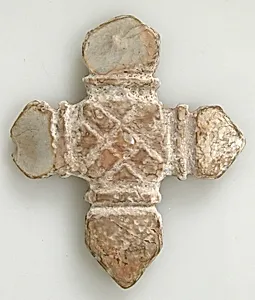
Medium
Shell
Dimensions
Overall: 1 1/2 x 1 1/4 x 3/16 in. (3.8 x 3.2 x 0.5 cm)
Classification
Miscellaneous-Shell
Culture
Byzantine
Department
Medieval Art
Museum
Metropolitan Museum of Art, New York, NY
Credit
Gift of J. Pierpont Morgan, 1917
Accession Number
17.191.200
Rights
Public Domain
Art Historical Context
This delicate *Shell Cross*, crafted by an unknown artist between 300 and 700 CE, exemplifies the portable piety of early Byzantine Christianity. Fashioned entirely from shell—a rare and lightweight medium—this tiny artifact measures just 1 1/2 x 1 1/4 x 3/16 inches, it was worn as a pendant, sewn into clothing, or carried as a personal talisman. The cross form, central to Byzantine religious devotion, symbolized Christ's sacrifice and protection against evil, reflecting the empire's fusion of Roman engineering with emerging Christian iconography. In the Byzantine world, spanning Constantinople's golden age, such objects bridged everyday life and spirituality. Shells, sourced from the Mediterranean, were valued for their natural luster and durability, often carved with precision to mimic precious materials like ivory or mother-of-pearl. This piece's placement in the Metropolitan Museum of Art's Medieval Art department highlights its role in the broader narrative of early medieval craftsmanship, gifted by financier J. Pierpont Morgan in 1917 to enrich public appreciation of Byzantine artistry. Though modest in scale, the *Shell Cross* invites us to ponder the faith of its long-ago owner—perhaps a pilgrim or merchant—toting divine safeguard through ancient trade routes. A testament to ingenuity with humble materials, it endures as a quiet jewel of cultural resilience.