
Shen Jian De|Discretion, Thrift and Virtue
late 19th–early 20th century
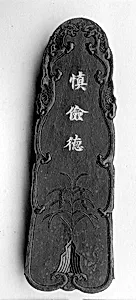
Medium
Black ink
Dimensions
W. 1 3/8 in. (3.5 cm); L. 4 in. (10.2 cm)
Classification
Ink
Culture & Period
China · late Qing dynasty (1644–1911) or early Republic period (1912–49)
Department
Asian Art
Museum
Metropolitan Museum of Art, New York, NY
Credit
Rogers Fund, 1930
Accession Number
30.76.225
Rights
Public Domain
Art Historical Context
Nestled among the treasures of the Metropolitan Museum of Art's Asian collection, *Shen Jian De|Dis, Thrift and Virtue* a delicate black inkstick crafted by Guzhai during the late Qing dynasty (4–1911) or early Republic period (191–49). Measuring just 1 3/8 inches wide 4 inches long, diminutive object exemplifies the refined artistry of China's scholarly traditions. Inksticks like this one were essential components of the "Four Treas of the Study"—brush, ink, paper and inkstone—used by literati to produce calligraphy and paintings. The title, inscribed elegantly on its surface, invokes Confucian ideals: *shen* (discretion), *jian* (thrift), and *de* (virtue). These virtues reflect the moral philosophy central to late imperial Chinese culture, where scholars prized restraint and ethical living amid dynastic transition and modernization. Jian Guzhai, a noted ink maker, elevated such utilitarian items into poetic artifacts, often embedding literary or philosophical motifs to inspire users. Crafted from soot and glue, the inkstick's glossy black surface reveals masterful calligraphy techniques, likely in seal script, transformed into a portable emblem of refinement. Acquired through the Rogers Fund in 1930, it invites visitors to appreciate how everyday scholarly tools embodied profound cultural values in a time of change.
About the Artist
Jian Guzhai
Jian Guzhai — meaning roughly "Studio for Appreciating the Antique" — was a renowned ink-tablet workshop operated by the Wang Jinsheng family in the Huizhou region of Anhui Province, China, one of the historic centers of fine inkstick production. Active during the late Qing dynasty (1644–1911) and possibly into the early Republic period (1912–49), the workshop was celebrated for producing ink tabl...