
Sherd
Unknown Artist
ca. early to mid-3rd millennium BCE
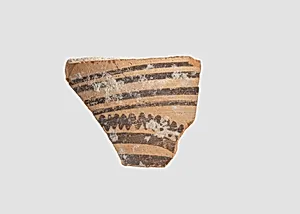
Medium
Ceramic
Dimensions
2.36 x 1.89 in. (5.99 x 4.8 cm)
Classification
Ceramics-Vessels
Culture & Period
Indus · Early Harappan
Department
Ancient Near Eastern Art
Museum
Metropolitan Museum of Art, New York, NY
Credit
Rogers Fund and Purchase, Joseph Pulitzer Bequest, by exchange, 1957
Accession Number
57.99.12
Rights
Public Domain
Art Historical Context
This delicate ceramic sherd, a fragment from an ancient vessel, offers a tantalizing glimpse into the Early Harappan period of the Indus Valley Civilization, dating to around the early to mid-rd millennium BCE. Discovered and acquired by the Metropolitan Museum of in 1957 through the Rogers Fund and Joseph Pulitzer Bequest, this piece—measuring just 2.36 x 1.89 inches—belongs to the museum's Ancient Near Eastern Art, highlighting the interconnected world of early Eurasian cultures. As part of the Indus culture, one of the world's earliest urban societies alongside Mesopotamia and Egypt, this sherd exemplifies the sophisticated pottery traditions that emerged in what is now Pakistan and northwest India. Early Harappan ceramics were typically wheel-thrown or hand-built, fired in kilns to achieve durability for everyday use, storage, and trade. Though worn by time, such fragments reveal the technical prowess of artisans who laid the groundwork for the Mature Harappan phase, famous for planned cities like Mohenjo-Daro and Harappa. For museum visitors, this unassuming relic underscores the quiet innovation of prehistoric peoples—evidence of a thriving economy and cultural exchange that shaped South Asian history long before written records. Imagine it as a puzzle piece from a lost world, inviting us to ponder the hands that shaped it millennia ago.