
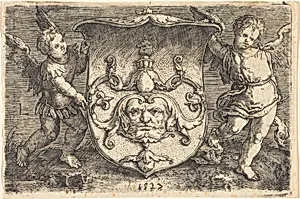
Shield with Mascaron
1401 to 1500
Medium
engraving
Classification
Department
CG-E
Museum
National Gallery of Art, Washington, D.C.
Credit
Rosenwald Collection
Accession Number
1943.3.5209
Rights
Public Domain
Art Historical Context
**Shield with Mascaron** Ludwig Krug (ca. 1460–1536) is a striking engraving from the late 15th century, in the National Gallery of's Rosenwald Collection. between 1401 and 1500, this print exemplifies the burgeoning art of engraving in Renaissance Germany, particularly in Nuremberg, where Krug worked as both a goldsmith and printmaker. The central motif—a mascaron, or grotesque face—adorns a heraldic shield, blending decorative flair with symbolic power typical of the period's armor and metalwork designs. Engraving, Krug's favored medium, involved incising fine lines into a metal plate with a burin, allowing ink to cling to the grooves for precise, reproducible images. This technique marked a shift from woodcuts, offering greater detail and tonal subtlety suited to intricate motifs like the snarling mascaron, which may evoke protective spirits or classical grotesques revived during the Renaissance. Prints like this served practical purposes: as patterns for silversmiths, jewelers, or armorers, bridging art and craft. Krug's work reflects Nuremberg's Golden Age, a hub of artistic innovation where printmaking democratized design. This piece, classified as a print in the CG-E department, invites us to appreciate how everyday objects like shields became canvases for artistic expression, safeguarding both body and imagination in a turbulent era.