
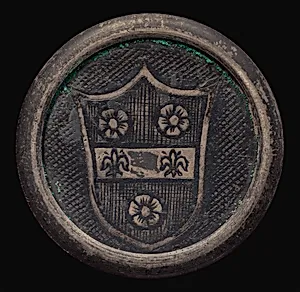
Shield with Three Roses and Two Lilies
late 15th/early 16th century
Medium
nielloed silver
Dimensions
diameter (without border): 1.7 cm (11/16 in.)
Classification
Sculpture
Department
CSD
Museum
National Gallery of Art, Washington, D.C.
Credit
Samuel H. Kress Collection
Accession Number
1961.9.140
Rights
Public Domain
Art Historical Context
This exquisite small shield, crafted in nielloed silver by an anonymous Italian artist of the late fifteenth or early sixteenth century, exemplifies the refined metalwork of the Renaissance. Measuring just 1.7 centimeters across, the piece features three roses and two lilies rendered in delicate contrast against the polished silver surface. The niello technique—where engraved lines are filled with a black metallic alloy—creates striking visual depth and was prized during this period for its ability to highlight intricate designs on jewelry, armor fittings, and devotional objects. Roses and lilies carried rich symbolic meanings in Renaissance Italy, often representing love, purity, and heraldic identity. Such motifs frequently appeared in coats of arms or personal emblems, suggesting this shield may have adorned a noble’s accessory or religious item. Its classification as sculpture, despite its miniature scale, underscores the era’s appreciation for fine craftsmanship in even the smallest forms. Housed in the National Gallery of Art’s Samuel H. Kress Collection, the work offers a glimpse into the sophisticated decorative arts of early modern Europe. It reflects a time when artists blended technical precision with symbolic expression, transforming functional or ornamental pieces into enduring statements of beauty and status.