
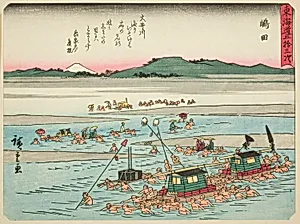
Shimada, from the series "Fifty-three Stations of the Tokaido (Tokaido gojusan tsugi)," also known as the Tokaido with Poem (Kyoka iri Tokaido)
c. 1837/42
Medium
Color woodblock print; chuban
Dimensions
17.1 × 22.8 cm (6 11/16 × 8 15/16 in.)
Classification
woodblock print
Department
Arts of Asia
Museum
Art Institute of Chicago
Accession Number
4351
Rights
Public Domain
Art Historical Context
Utagawa Hiroshige's *Shimada*, from the renowned series *Fifty-three Stations the Tōkaidō (Tōkaidō Gojūsan-tsugi)*—also called *Tōkaidō with Poem (Kyōka iri Tōkaidō)*—captures a moment along Japan's historic coastal highway connecting Edo (modern Tokyo) to Kyoto. Created around 1837–42, this chuban-sized color woodblock print (17.1 × 22.8 cm) depicts Shimada station, one of 53 official post towns bustling with travelers during the Edo period (1603–1868). Hiroshige, a master of the ukiyo-e ("pictures of the floating world") school, infused the scene with poetic kyōka verses, blending visual artistry with playful literature. The Tōkaidō series, first published in 1833–34, became an instant sensation, romanticizing the arduous journey mandated for daimyo under the shogunate's sankin-kōtai system. Hiroshige's genius lies in his atmospheric landscapes: subtle gradations of color (via bokashi shading techniques), dynamic compositions, and evocative weather effects that convey transience and beauty. Printed on washi paper using intricate multi-block carving, these affordable ukiyo-e democratized art for everyday viewers. Hiroshige's work profoundly influenced Western artists like Van Gogh and Monet, bridging Eastern and Western aesthetics. Today, housed in the Art Institute of Chicago's Arts of Asia collection, *Shimada* invites us to ponder the poetry of passage in a pre-industrial world.
About the Artist
Utagawa Hiroshige · 1826–1869
Utagawa Hiroshige (1797–1858), born Andō Tokutarō, was the last great master of Japanese ukiyo-e woodblock printmaking and one of the most influential landscape artists in history. Born in Edo (modern Tokyo) into a low-ranking samurai family serving as fire wardens, Hiroshige transformed landscape printmaking into a poetic meditation on nature, weather, and everyday life. His revolutionary approac...