
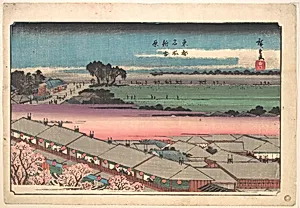
東都名所 新吉原|Shin Yoshiwara
ca. 1840
Medium
Woodblock print; ink and color on paper
Dimensions
10 5/16 x 14 7/8 in. (26.2 x 37.8 cm)
Classification
Prints
Culture & Period
Japan · Edo period (1615–1868)
Department
Asian Art
Museum
Metropolitan Museum of Art, New York, NY
Credit
Purchase, Joseph Pulitzer Bequest, 1918
Accession Number
JP616
Rights
Public Domain
Tags
Art Historical Context
**Shin Yoshiwara** by Utagawa Hirosh (ca. 1840) captures the allure of one of Edo's (modern Tokyo's) most vibrant districts during the Edo period (1615–1868). Part of Hiroshige's series *amous Places of the Eastern Capital*, this woodblock print depicts Shin Yoshi, the official pleasure quarter relocated in 1657 to the city's outskirts. Framed by lush trees and traditional houses, the scene evokes the district's elegant teahouses and willow-lined streets, a hub of entertainment where courtesans, theater, and nightlife flourished under strict government regulation. Hiroshige, a master of the ukiyo-e ("pictures of the floating world") movement, excelled in landscape prints that blended everyday beauty with poetic atmosphere. His innovative use of color—achieved through layered woodblocks inked with pigments—brings a vivid, almost luminous quality to the paper, highlighting subtle gradients in foliage and twilight skies. These affordable prints democratized art, circulating widely among urban dwellers and influencing later Impressionists like Monet. This Metropolitan Museum of Art treasure, purchased in 1918, offers a window into Edo's social tapestry, where pleasure districts symbolized both transience and urban sophistication. Visitors today can appreciate how Hiroshige transformed a notorious locale into a serene, harmonious vista. (198 words)
About the Artist
Utagawa Hiroshige · 1826–1869
Utagawa Hiroshige (1797–1858), born Andō Tokutarō, was the last great master of Japanese ukiyo-e woodblock printmaking and one of the most influential landscape artists in history. Born in Edo (modern Tokyo) into a low-ranking samurai family serving as fire wardens, Hiroshige transformed landscape printmaking into a poetic meditation on nature, weather, and everyday life. His revolutionary approac...