
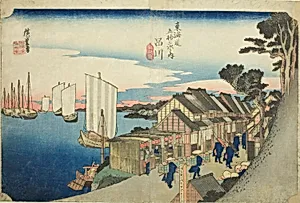
Shinagawa: Sunrise (Shinagawa, hinode), from the series "Fifty-three Stations of the Tokaido Road (Tokaido gojusan tsugi no uchi)," also known as the Hoeido Tokaido
c. 1833/34
Medium
Color woodblock print; oban
Dimensions
23.5 × 37.5 cm (9 1/4 × 14 1/2 in.)
Classification
woodblock print
Department
Arts of Asia
Museum
Art Institute of Chicago
Accession Number
25551
Rights
Public Domain
Art Historical Context
Utagawa Hiroshige's *Shinagawa: Sunrise*Shinagawa, hinode) captures the poetic beauty of dawn at the first station along the historic Tōkaidō Road, the vital coastal route connecting Edo (modern Tokyo) Kyoto during Japan's Edo period (1603–1868). around 1833–34 as part of the renowned series *Fifty-three Stations the Tōkaidō Road*—also called the Hōeidō Tōkaidō—this print is one of Hiroshige masterpieces in the ukiyo-e tradition, celebrating landscapes, travel, and fleeting moments of nature. Printed in vibrant colors on woodblock as an ōban sheet (measuring 23.5 × 37.5 cm), the artwork showcases Hiroshige's mastery of atmospheric effects. Subtle gradations of pink and orange skies blend with misty horizons, evoking the serene hush of daybreak over Shinagawa's shoreline and distant Mount Fuji, a motif that defined his lyrical style and influenced later artists worldwide. Housed in the Art Institute of Chicago's Arts of Asia collection, this piece reflects the cultural boom of affordable woodblock prints in 19th-century Japan, making grand scenery accessible to everyday people. It embodies the wanderlust of the Tōkaidō pilgrims and traders, immortalizing a journey that symbolized national unity and artistic innovation.
About the Artist
Utagawa Hiroshige · 1826–1869
Utagawa Hiroshige (1797–1858), born Andō Tokutarō, was the last great master of Japanese ukiyo-e woodblock printmaking and one of the most influential landscape artists in history. Born in Edo (modern Tokyo) into a low-ranking samurai family serving as fire wardens, Hiroshige transformed landscape printmaking into a poetic meditation on nature, weather, and everyday life. His revolutionary approac...