
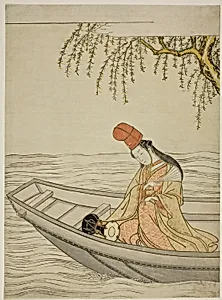
Shirabyoshi Dancer in Asazuma boat
c. 1766
Medium
Color woodblock print; chuban
Dimensions
28 × 20.4 cm (11 × 8 in.)
Classification
woodblock print
Department
Arts of Asia
Museum
Art Institute of Chicago
Accession Number
64397
Rights
Public Domain
Art Historical Context
Suzuki Harunobu's *Shirabyoshi Dancer in Asazuma Boat* (c. 1766) captures a graceful moment from Japan's Edo-period "floating world" (ukiyo-e), where everyday pleasures and classical traditions intertwined. Harunobu, a pioneeringkiyo-e master, depicts a shirabyoshi—a female dancer known for her elegant, androgynous performances inspired by Heian-era nobility. Poised in a boat named Asazuma (evoking scenic Sum River locales), she embodies poetic beauty and transient joy, a hallmark of bijin-ga (pictures of beautiful women). This chuban-format color woodblock print (28 × 20.4 cm) showcases Harunobu's revolutionary *nishiki-e* technique, using multiple woodblocks for vibrant, multi-layered hues—pink kimonos, misty waters, and subtle gradients—that brought unprecedented realism to prints around 1765. Smaller than larger oban sheets, chuban prints were affordable and intimate, popular for private collections. Housed in the Art Institute of Chicago's Arts of Asia department, this work highlights ukiyo-e's cultural role in democratizing art, blending reverence for historical dance with urban sophistication. Visitors, imagine the rustle of silk and river breeze as Harunobu freezes elegance in ink and color!
About the Artist
Suzuki Harunobu · 1725–1770
Suzuki Harunobu (c. 1725-1770) was a Japanese ukiyo-e artist who revolutionized woodblock printing by developing nishiki-e—full-color prints using multiple woodblocks—in 1765. Before Harunobu, Japanese prints were limited to two or three colors; his innovation unleashed the entire artist's palette, transforming ukiyo-e into the vibrant art form that would later captivate Western artists from Manet...