
Short Temple Pendant, One of a Pair
Unknown Artist
mid-to late 19th century
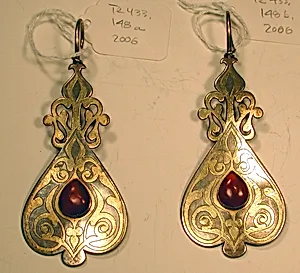
Medium
Silver; fire-gilded and chased, with openwork and cabochon carnelians
Dimensions
H. 5 in. (12.7 cm) W. 2 1/8 in. (5.4 cm)
Classification
Jewelry
Department
Islamic Art
Museum
Metropolitan Museum of Art, New York, NY
Credit
Gift of Marshall and Marilyn R. Wolf, 2015
Accession Number
2015.648.12a
Rights
Public Domain
Tags
Art Historical Context
This exquisite *Short Temple Pendant, One of a Pair* hails from the Islamic Art collection at the Metropolitan Museum of Art, a delicate jewel crafted by an unknown artist in the mid- to late 19th century. Standing 5 inches tall and 2⅛ inches wide, it is fashioned from silver, enhanced through fire-gilding—a technique that applies a thin gold-mercury amalgam and fires it to create a luminous sheen without using solid gold. Intricate chasing forms raised designs hammered from the reverse, while openwork pierces the metal for airy elegance, accented by smooth cabochon carnelians that add vibrant red pops of color. In 19th-century Islamic jewelry traditions, such pendants were prized adornments, likely worn suspended from the hair or ears as part of elaborate temple jewelry ensembles in regions like the Indian subcontinent. The combination of techniques highlights masterful metalwork, blending functionality with opulence—openwork allowed lightness for daily wear, while carnelians evoked protection and prosperity. As one of a pair, it would have created symmetrical grandeur, symbolizing status and cultural heritage. Generously gifted by Marshall and Marilyn R. Wolf in 2015, this pendant invites us to marvel at the anonymous artisan's skill, bridging personal devotion and artistic legacy in Islamic ornamental arts.