
Shoulder Band Fragment
Unknown Artist
4th–5th century
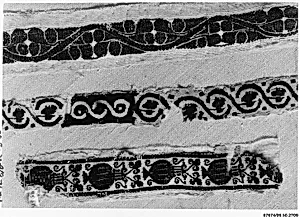
Medium
Linen, wool; tapestry weave
Dimensions
H. 15 1/2 in. (39.4 cm) W. 1 1/4 in. (3.2 cm)
Classification
Textiles
Department
Islamic Art
Museum
Metropolitan Museum of Art, New York, NY
Credit
Rogers Fund, 1909
Accession Number
09.50.2709
Rights
Public Domain
Art Historical Context
This delicate *Shoulder Band Fragment*, dating to the 4th–5th century, offers a glimpse into the sophisticated textile traditions of the early medieval world. Crafted from linen and wool using tapestry weave—a technique where colorful weft threads fully cover the warp to create vibrant, durable patterns—this narrow strip (just 1¼ inches wide and 15½ inches long) adorned the shoulder of a tunic or garment. Such bands were prized for their ornamental role, transforming everyday clothing into status symbols in regions spanning the Mediterranean and Near East. Tapestry weave, a hallmark of ancient weaving mastery, allowed artisans to depict motifs like geometric designs, animals, or figures with remarkable precision, akin to painting on fabric. Though the artist remains unknown, this fragment exemplifies the technical prowess of Late Antique textile production, possibly from Egypt or the Levant, where linen's breathability paired perfectly with wool's warmth and colorfast dyes. Its preservation highlights the era's advanced dyeing and weaving skills, bridging pagan, Christian, and emerging Islamic cultures. Housed in the Metropolitan Museum of Art's Islamic Art Department (acquired via the Rogers Fund in 1909), this tiny treasure underscores textiles' role as portable art, traded along Silk Road routes and buried in arid tombs for millennia. A reminder that beauty often survives in fragments!