
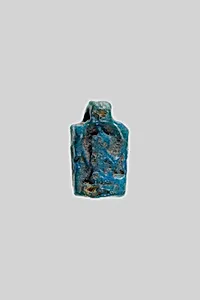
Shu amulet
Unknown Artist
ca. 1295–1070 B.C.
Medium
Faience
Dimensions
H. 1.4 × W. 0.9 × D. 0.4 cm (9/16 × 3/8 × 3/16 in.)
Classification
Amulet, Shu
Period
New Kingdom, Ramesside
Department
Egyptian Art
Museum
Metropolitan Museum of Art, New York, NY
Credit
Rogers Fund, 1909
Accession Number
09.180.2381
Rights
Public Domain
Art Historical Context
This delicate faience amulet depicts Shu, the ancient Egyptian god of air and light from the New Kingdom's Ramesside period (. 1295–1070 B.C., Dynasties 19–20). Measuring just 1.4 cm high, it was likely worn as a personal protective charm, reflecting the era's deep integration of religion into everyday life. Crafted during a time of imperial grandeur under pharaohs like Ramesses, such small artifacts highlight the accessibility of divine protection beyond elite tombs. Shu played a vital role in Egyptian cosmology as the god who separated sky goddess Nut from earth god Geb, creating the space for life and breath itself—symbolizing wind, sunlight, and order from chaos. Amulets like this invoked his power to safeguard the wearer from harm, illness, or evil spirits, embodying the New Kingdom belief in amuletic magic for both the living and the dead. Faience, a glazed quartz-based ceramic, was prized for its brilliant turquoise hue, evoking precious stones like lapis lazuli at a fraction of the cost. Molded and fired to achieve a glassy sheen, this technique allowed mass production of vibrant, durable talismans, underscoring Egypt's innovative artistry in blending utility, spirituality, and beauty. Acquired through the Rogers Fund in 1909, it now graces the Metropolitan Museum of Art's Egyptian collection.