
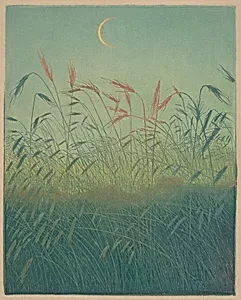
Sickle Moon over a Cornfield
Medium
etching printed in color on wove paper
Dimensions
plate: 180 x 145 cm (70 7/8 x 57 1/16 in.) sheet: 26 x 28 cm (10 1/4 x 11 in.)
Classification
Department
CG-E
Museum
National Gallery of Art, Washington, D.C.
Credit
Gift of Ruth Cole Kainen
Accession Number
2012.92.302
Rights
Public Domain
Art Historical Context
In the tranquil etching *Sickle Moon over a Corn* (1896), German artist Karl Wilhelm Arthur Ill evokes the quiet poetry of rural nightfall. The composition centers on a slender, curved sickle moon hovering above undulating cornstalks, a moment of serene natural harmony. Created at the fin-de-siècle, when artists increasingly romanticized the countryside amid rapid industrialization, this print reflects a nostalgic gaze toward agrarian life in late 19th-century Europe. Illies employs a sophisticated color etching technique on wove paper, layering inks to achieve subtle tonal gradients and luminous effects that mimic painting. This medium was innovative for prints, allowing intricate details—like the moon's glow and textured foliage—while enabling affordable reproduction. The modest plate size (18 x 14.5 cm) contrasts with the artwork's expansive mood, inviting intimate contemplation. Now housed in the National Gallery of Art's print collection (gift of Ruth Cole Kainen), this piece highlights the era's advancements in printmaking, bridging fine art and accessibility for broader audiences.