
Side-blown Trumpet
Unknown Artist
18th–19th century
Medium
Ivory
Dimensions
Length 11-1/4 in.
Classification
Bone/Ivory-Musical Instruments
Culture
Yoruba peoples
Department
Arts of Africa, Oceania, and the Americas
Museum
Metropolitan Museum of Art, New York, NY
Credit
Gift of Mr. and Mrs. Klaus G. Perls, 1991
Accession Number
1991.17.110
Rights
Public Domain
Tags
Art Historical Context
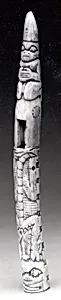
This exquisite side-blown trumpet, crafted from ivory by an unknown Yoruba artist in 18th–19th century, exemplifies the masterful carving traditions of the Yoruba of West Africa, particularly in present-day Nigeria. Measuring just 11-1/4 inches in length, its compact form belies its cultural weight as a musical instrument played by blowing across a side hole, producing resonant tones for communal rituals, royal ceremonies, and festivals. Ivory, sourced from elephant tusks, a prized material among Yoruba artisans, symbolizing prestige and spiritual power due to its rarity and workability. The trumpet's surface likely features intricate human figures—common in Yoruba ivory carvings—depicting ancestors, deities, or performers, which imbued the object with narrative and protective significance. These motifs reflect the Yoruba worldview, where art and music intertwined to honor the divine orki (souls) and reinforce social hierarchies. Such instruments were essential in egungun masquerades or praise-singing ensembles, amplifying voices in praise of kings and honoring the community's history. Now housed in the Metropolitan Museum of Art's Department of Arts of Africa, Oceania, and the Americas (gift of Mr. and Mrs. Klaus G. Perls, 1991), this trumpet invites us to hear the echoes of Yoruba vitality, bridging sound, sculpture, and spirituality across centuries.