
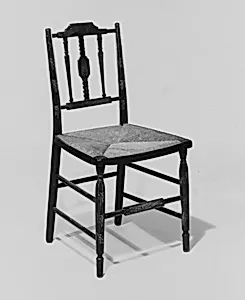
Side Chair
Unknown Artist
1800–1810
Medium
Maple, ash, tulip poplar
Dimensions
Dimensions unavailable
Classification
Side Chair
Culture
American
Department
The American Wing
Museum
Metropolitan Museum of Art, New York, NY
Credit
Rogers Fund, 1974
Accession Number
1974.38
Rights
Public Domain
Art Historical Context
This elegant side chair, crafted between 1800 and 1810 by an unknown American artisan, exemplifies the Federal style that defined early 19th-century American furniture. Emerging in the post-Revolutionary era, this period celebrated the young nation's neoclassical aspirations, drawing inspiration from ancient Greek and Roman designs adapted to everyday life. Simple yet refined, such chairs furnished parlors and dining rooms in prosperous households, symbolizing emerging American identity and self-reliance in craftsmanship. Made from native hardwoods—maple for its durability and fine grain, ash for strength, and tulip poplar for lightweight secondary elements—the chair highlights regional woodworking traditions, likely from New England or the Mid-Atlantic workshops. These woods were sustainably sourced and readily available, underscoring the practical ingenuity of American makers who blended functionality with subtle ornamentation, such as turned legs or carved details typical of the time. Housed in The Metropolitan Museum of Art's American Wing and acquired through the Rogers Fund in 1974, this piece offers a tangible glimpse into domestic life during America's formative years. It reminds us how ordinary objects like this chair carried the weight of cultural progress, bridging colonial roots with a bold new republic.