
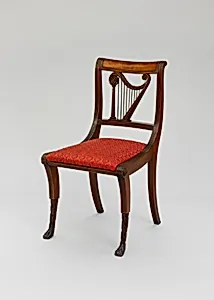
Side Chair
Unknown Artist
1810–20
Medium
Mahogany, brass, ash, and tulip poplar
Dimensions
32 1/4 x 21 3/4 x 18 3/8 in. (81.9 x 55.2 x 46.7 cm)
Classification
Side Chair
Culture
American
Department
The American Wing
Museum
Metropolitan Museum of Art, New York, NY
Credit
John Stewart Kennedy Fund, by exchange, 1972
Accession Number
1972.136
Rights
Public Domain
Tags
Art Historical Context
This elegant side chair, crafted between 1810 and 1820 by an unknown American maker, exemplifies the refined craftsmanship of the early Federal period. Made primarily from rich mahogany—a prized imported wood symbolizing luxury—with secondary woods like ash and tul poplar for structural support and accented by brass, it measures 32¼ x 21¾ x 18⅜ inches. Such chairs were essential furnishings in prosperous American homes, often used in dining rooms or parlors as part of coordinated sets. The design likely draws from neoclassical influences popular at the time, with the "Harps" tag suggesting decorative motifs inspired by classical lyres or harp shapes, common in high-style furniture to evoke antiquity and sophistication. Mahogany's durability and fine grain allowed for precise carving and veneering techniques, showcasing the skilled joinery of American cabinetmakers adapting European styles to local tastes. Acquired through the John Stewart Kennedy Fund in 1972 and housed in The Metropolitan Museum of Art's American Wing, this chair offers a tangible glimpse into early 19th-century domestic life, highlighting the growing confidence of American artisans in creating heirloom-quality pieces for a new nation's elite.