
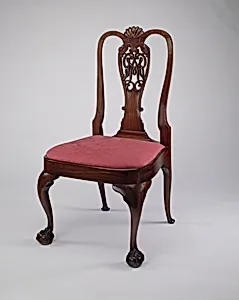
Side Chair
1742–90
Medium
Mahogany, white oak, white pine, and beech
Dimensions
108.6 × 58.4 × 54.6 cm (41 3/4 × 23 × 21 1/2 in.)
Classification
seating
Department
Arts of the Americas
Museum
Art Institute of Chicago
Accession Number
35702
Rights
Public Domain
About this artwork
This chair is from a set made to commemorate either the marriage of Judge Robert Livingston and his wife Margaret, in 1742, or that of their son Robert and his wife Mary, in 1770. The “RML” cipher-pierced back splat is unique in American chair design of this period. The contrast of the high-style Chippendale design with the crude craftsmanship of the carvings suggests that the chair was worked on by several hands or that it was made by a country craftsman unfamiliar with practices of the more so...
Art Historical Context
This elegant side chair, crafted between 1742 and 1790, exemplifies the refined woodworking traditions of colonial America. Standing at 108.6 × 58.4 × 54.6 cm, it was constructed from premium mahogany for the visible surfaces—prized for its rich reddish-brown grain and durability—paired with white oak, white pine, and beech for structural elements. These woods reflect the era's resourceful craftsmanship, where imported mahogany signaled wealth and sophistication, often sourced from the Caribbean for high-end furniture in prosperous households. Housed in the Art Institute of Chicago's Arts of the Americas department, this anonymous masterpiece highlights the anonymous skilled artisans of the time, whose joinery techniques—such as mortise-and-tenon joints and dovetailing—ensured both strength and graceful proportions. Side chairs like this were essential to formal parlors, embodying the neoclassical influences of the late 18th century, with their balanced lines suited for social gatherings or quiet reflection. Though the maker remains unknown, the chair's survival speaks to its enduring quality, offering visitors a tangible link to everyday life in early America, where furniture doubled as a canvas for cultural aspiration and technical mastery.