
Sideboard Table
1940
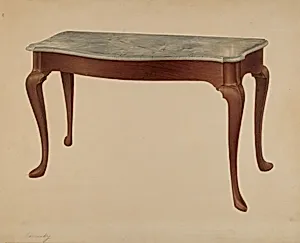
Medium
watercolor, colored pencil, and graphite on paperboard
Dimensions
overall: 38.1 x 50.7 cm (15 x 19 15/16 in.) Original IAD Object: none given
Classification
Index of American Design
Department
CG-W
Museum
National Gallery of Art, Washington, D.C.
Credit
Index of American Design
Accession Number
1943.8.5706
Rights
Public Domain
Art Historical Context
Behold the *Sideboard Table*, a meticulous 1940 rendering by Isid Sovensky, part of the esteemed Index of American Design (IAD) at the National Gallery of Art Created during the Great Depression-era Works Progress Administration (WPA the IAD commissioned over 15,000 watercolor illustrations by artists like Sovensky document America's rich heritage of folk, decorative, and industrial arts. This 38.1 x 50.7 cm work on paperboard captures the elegant form of a classic sideboardlikely an heirloom piece from early American cabinetmaking—preserving its craftsmanship for posterity amid economic hardship. Sovensky's masterful use of watercolor, colored pencil, and graphite brings the furniture to life with striking precision. Delicate washes evoke wood grains and polished surfaces, while fine pencil lines delineate intricate joinery, turned legs, and ornamental details, showcasing the hybrid technique central to IAD works. This approach not only highlighted regional styles but also celebrated the anonymous artisans behind everyday objects turned icons of national identity. Today, this piece underscores the IAD's enduring legacy: a visual archive that democratized art history, influencing mid-20th-century design revival and reminding us how furniture embodied American ingenuity and cultural evolution. A true gem for design enthusiasts!
About the Artist
Isidore Sovensky · 1855–present
Isidore Sovensky is an artist whose life and career remain poorly documented in the historical record. No confirmed birth or death dates have been established, and the precise national or cultural context in which he worked is uncertain. The surviving works attributed to him suggest activity during the nineteenth century, but the specifics of his training, patrons, and professional milieu have yet...