
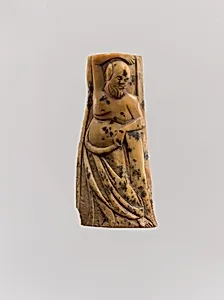
Silenus, the Tutor of Dionysos
Unknown Artist
4th–7th century
Medium
Bone
Dimensions
Overall: 4 3/16 x 1 3/4 x 3/4 in. (10.7 x 4.5 x 1.9 cm)
Classification
Ivories-Bone
Culture
Byzantine
Department
Medieval Art
Museum
Metropolitan Museum of Art, New York, NY
Credit
Rogers Fund, 1907
Accession Number
07.228.44
Rights
Public Domain
Tags
Art Historical Context
Nestled in the Metropolitan Museum of Art's Medieval Art collection, *Silenus, the Tutor of Dionysos* is a delicate bone carving from the early Byzantine era (4th–7th century). This small-scale artwork, measuring just 4 3/16 x 1 3/4 x 3/4 inches, captures Silenus—the merry, wine-loving companion and foster father to the Greek god Dionysos (Bacchus)—in a style that echoes classical antiquity. Crafted by an unknown artist, it exemplifies Byzantine ivory-bone work, a technique prized for its fine detail and portability, often used for personal devotional or decorative objects. Produced during the transition from the late Roman Empire to the fully Christian Byzantine world, this piece highlights the enduring influence of pagan mythology amid rising Christian dominance. Bone, a readily available and workable medium, allowed artisans to create intricate reliefs or figurines that could be carried as talismans or adornments. Its survival speaks to the skill of Byzantine craftsmen, who adapted Roman carving traditions to produce objects blending Greco-Roman themes with emerging imperial aesthetics. Today, acquired through the Rogers Fund in 1907, this artifact invites visitors to ponder the cultural crossroads of myth and faith, offering a tangible link to a vibrant, myth-infused past.