
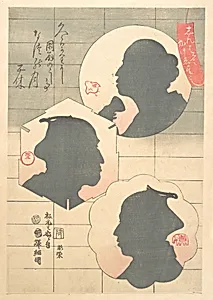
Silhouette Image of Kabuki Actor
19th century
Medium
Woodblock print; ink and color on paper
Dimensions
Approx. 14 1/2 x 9 1/2 in. (36.8 x 24.1 cm)
Classification
Prints
Culture & Period
Japan · Meiji period (1868–1912)
Department
Asian Art
Museum
Metropolitan Museum of Art, New York, NY
Credit
Bequest of Mary Martin, 1938
Accession Number
JP2748.3
Rights
Public Domain
Tags
Art Historical Context
This striking woodblock print captures the dramatic profile of a Kabuki actor, rendered in bold silhouette against a simple background. Created by Utagawa Kuniteru during Japan’s Meiji period (1868–1912), the work belongs to a long tradition of ukiyo-e actor prints that celebrated the stars of the Kabuki stage. These images served as both souvenirs and visual records of performances, allowing audiences to relive the expressive gestures and distinctive makeup of their favorite actors. Printed with ink and color on paper using the woodblock technique, the piece highlights the medium’s ability to produce sharp outlines and rich contrasts. The silhouette format emphasizes the actor’s distinctive pose and costume contours, drawing the viewer’s eye to the theatricality of Kabuki rather than individual facial details. Such prints were affordable and widely circulated, bridging high art and popular entertainment in 19th-century Japan. Housed in the Metropolitan Museum of Art’s Asian Art department, this print reflects the enduring cultural importance of Kabuki during a time of rapid modernization. It offers today’s visitors a glimpse into Japan’s vibrant theater traditions and the artists who helped preserve their visual legacy.