
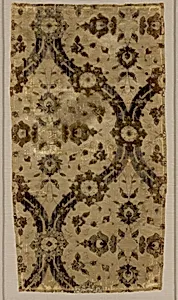
Silk Velvet Designed by 'Ghiyath'
second half 16th century
Medium
Silk, cut and voided velvet with continuous floats of flat metal thread
Dimensions
Textile: L. 25 3/4 in. (65.4 cm) W. 13 1/4 in. (33.7 cm) Mount: L. 30 in. (76.2 cm) W. 18 1/2 in. (47 cm)
Classification
Textiles
Department
Islamic Art
Museum
Metropolitan Museum of Art, New York, NY
Credit
Purchase, Joseph Pulitzer Bequest, 1952
Accession Number
52.20.13
Rights
Public Domain
Art Historical Context
This exquisite silk velvet textile, designed by the artist Ghiyath in the second half of the sixteenth century, showcases the refined artistry of Islamic textile traditions. Created with cut and voided velvet incorporating continuous floats of flat metal thread, the piece exemplifies the luxurious materials and intricate craftsmanship prized in courtly and ceremonial contexts of the period. Its compact dimensions suggest it may have served as a panel for garments, furnishings, or decorative hangings, highlighting the versatility of such fabrics in daily elite life. Ghiyath’s design reflects the sophisticated weaving techniques developed in Persian and broader Islamic workshops, where silk velvets with metallic elements created shimmering patterns that caught light dramatically. The use of voided areas and metal threads not only enhanced visual depth but also demonstrated the technical mastery required to produce these labor-intensive textiles. Acquired by the Metropolitan Museum of Art in 1952 through the Joseph Pulitzer Bequest, this work offers visitors a tangible connection to the opulent artistic heritage of the Islamic world.