
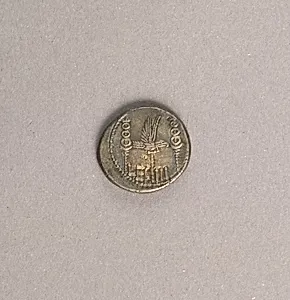
Silver denarius of Marcus Antonius
Unknown Artist
32–31 BCE
Medium
Silver
Dimensions
11/16 × 1/16 in., 3.7g (1.8 × 0.2 cm, 3.7g)
Classification
Coins
Culture & Period
Roman · Late Republican
Department
Greek and Roman Art
Museum
Metropolitan Museum of Art, New York, NY
Credit
Rogers Fund, 1908
Accession Number
08.170.69
Rights
Public Domain
Tags
Art Historical Context
Step into the turbulent world of Late Republican Rome with this silver denarius struck by Marcus Antonius (Mark Antony) around 32–31 BCE. As one of Rome's most notorious triumvirs, Antony minted these coins amid his power struggle with Octavian (future Augustus), just before the decisive Battle of Actium. The denarius, Rome's standard silver currency weighing about 3.7 grams, circulated widely and served as both money and military pay, funding Antony's legions loyal to him. Crafted through precise die-striking techniques, the coin showcases Roman mastery of miniature portraiture and symbolism. Eagles—evident in the design—were sacred emblems of Jupiter and the Roman legions, rallying troops and asserting Antony's command over his forces. Though small (just 1.8 cm across), its intricate details reflect the era's propaganda artistry, where coins broadcast political allegiance more potently than words. Housed in the Metropolitan Museum of Art's Greek and Roman Art department (acquired via Rogers Fund, 1908), this piece illuminates the fragility of the Republic's end. It whispers of ambition, civil war, and the rise of empire, inviting us to ponder how a tiny coin captured the fate of Rome.