
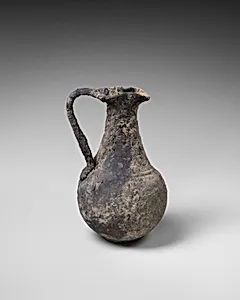
Silver jug
Unknown Artist
ca. 750 BCE
Medium
Silver
Dimensions
H. 6 1/4 in. (15.9 cm)
Classification
Gold and Silver
Culture & Period
Cypriot · Cypro-Geometric III–Cypro-Archaic I
Department
Greek and Roman Art
Museum
Metropolitan Museum of Art, New York, NY
Credit
The Cesnola Collection, Purchased by subscription, 1874–76
Accession Number
74.51.4592
Rights
Public Domain
Art Historical Context
This delicate silver jug, dating to around 750 BCE, hails from ancient Cyprus during the Cypro-Geometric III to Cypro-Archaic I period—a transitional era when the island's vibrant culture blended Eastern Mediterranean influences. Standing just 6¼ inches (15.9 cm) tall, this vessel exemplifies the Cypriots' mastery of metalworking, a craft bolstered by the region's rich copper deposits and bustling trade networks linking Greece, the Near East, and Egypt. Jugs like this were likely used for pouring wine or water in elite households or rituals, reflecting everyday luxury in a prosperous seafaring society. Crafted from pure silver, the jug highlights Cyprus's role as a cultural crossroads, where geometric motifs and emerging figural styles began to evolve from earlier pottery traditions into more refined forms. Though decoration details are subtle, its sleek form and hammered construction showcase advanced techniques that bridged Bronze Age legacies with the Archaic world. Part of the renowned Cesnola Collection—acquired by subscription in 1874–76 and now housed in the Metropolitan Museum of Art's Greek and Roman Art department—this piece offers a tangible glimpse into Cyprus's golden age of artistry. (198 words)