
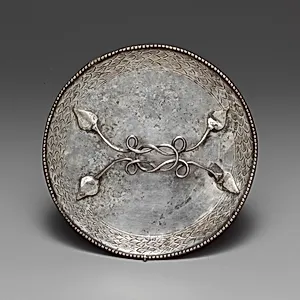
Silver mirror
Unknown Artist
4th century CE
Medium
Silver
Dimensions
Diam.: 5 3/16 in. (13.2 cm)
Classification
Gold and Silver
Culture & Period
Roman · Imperial
Department
Greek and Roman Art
Museum
Metropolitan Museum of Art, New York, NY
Credit
Gift of Norbert Schimmel Trust, 1989
Accession Number
1989.281.82
Rights
Public Domain
Tags
Art Historical Context
This exquisite silver mirror, dating to the 4th century CE, hails from the Roman Imperial period and exemplifies the refined metalworking of Late Antiquity. Measuring just 5 3/16 inches (13.2 cm) in, it was a portable luxury item, likely used for personal grooming by affluent Romans. Crafted from polished silver—a precious metal prized for its lustrous reflectivity—this mirror reflects the empire's advanced techniques in hammering, chasing, and polishing, which produced highly functional yet elegant objects. In Roman culture, mirrors were more than utilitarian; they symbolized beauty, vanity, and social status, often appearing in literature by poets like Ovid. During the 4th century, as the empire faced transitions amid Christianization and barbarian pressures, such items persisted as markers of elite sophistication, sometimes found in wealthy households or burials. The unknown artisan's skill highlights the continuity of Greco-Roman craftsmanship in an era of cultural flux. Today, this mirror graces the Metropolitan Museum of Art's Greek and Roman Art department, a gift of the Norbert Schimmel Trust in 1989. It invites us to ponder the daily lives of Romans, gazing back through time at their polished world.