
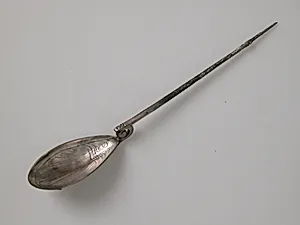
Silver Spoon
Unknown Artist
4th–5th century
Medium
Silvered Copper alloy
Dimensions
Overall: 7 7/16 x 1 1/8 x 5/8 in. (18.9 x 2.9 x 1.6 cm)
Classification
Metalwork-Copper alloy
Culture
Late Roman
Department
Medieval Art
Museum
Metropolitan Museum of Art, New York, NY
Credit
Gift of J. Pierpont Morgan, 1917
Accession Number
17.191.211
Rights
Public Domain
Art Historical Context
This delicate silver spoon, crafted in the Late Roman period (4th–5th), offers a glimpse into the everyday elegance of the waning Roman Empire. Measuring just 7 7/16 inches long, it was made from a copper alloy coated with silver—a clever technique that mimicked the luster of pure silver while keeping costs accessible to the middle classes. Such utensils were essential for dining, mixing, and serving, reflecting the refined table manners that spread across the Roman world from Britain to the eastern provinces. The spoon's creation during Late Antiquity marks a transitional era, as the Roman Empire grappled with invasions, Christianity's rise, and cultural shifts toward the medieval world. Artisans employed skilled metalworking methods, likely involving mercury amalgamation or foil application to achieve the shimmering silver surface on the durable copper base. This piece exemplifies the period's blend of functionality and subtle luxury, where even humble objects bore traces of imperial sophistication. Housed in The Metropolitan Museum of Art's Medieval Art department (gift of J. Pierpont Morgan, 1917), this spoon highlights the continuity of Roman craftsmanship into early medieval Europe. Visitors can appreciate how such small artifacts reveal the lives of ordinary Romans, bridging antiquity and the Middle Ages with quiet artistry.