
Sir John Ogle
published 1657
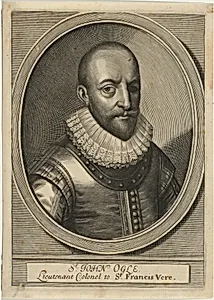
Medium
engraving
Dimensions
plate: 20 × 14 cm (7 7/8 × 5 1/2 in.)
Classification
Department
CG-E
Museum
National Gallery of Art, Washington, D.C.
Credit
Rosenwald Collection
Accession Number
1951.11.715
Rights
Public Domain
Art Historical Context
Behold *Sir John Ogle*, a striking 1657 engraving by the renowned English artist William Faithorne. Faithorne, a master engraver and miniaturist in the turbulent mid-17th century, captured the likeness of Sir John Ogle a notable figure likely from the era's military or noble circles. Published during the Commonwealth period following England's Civil Wars, this portrait reflects the era's fascination with heroic individuals amid political upheaval. Crafted as an intaglio engraving on a modest plate measuring 20 × 14 cm, the work showcases Faithorne's virtuosic technique. Engraving allowed for intricate line work and rich tonal contrasts, producing durable prints that could be widely disseminated—a revolutionary medium for portraiture at the time. Faithorne's precise incisions bring out the subject's dignified features, emblematic of the period's shift toward detailed, realistic representation influenced by Continental masters like Van Dyck. Housed in the National Gallery of Art's Rosenwald Collection (Department CG-E), this print exemplifies the artistic legacy of 17th-century British engraving. It invites visitors to ponder Ogle's story against the backdrop of Restoration anticipation, blending technical brilliance with historical resonance.
About the Artist
William Faithorne · 1615–1691
William Faithorne, often called "the Elder" (c. 1616–1691), was a pioneering English engraver, printmaker, and portrait painter whose masterful line engravings elevated the craft in seventeenth-century Britain. Born in London to a bit-maker, he was apprenticed in 1635 to the printseller William Peake for a decade; following Peake's early death in 1639, he continued under Robert Peake and received ...