
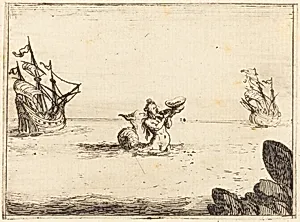
Siren between Two Ships
1628
Medium
etching on laid paper
Dimensions
plate: 6 × 8.2 cm (2 3/8 × 3 1/4 in.) sheet: 9.6 × 11.6 cm (3 3/4 × 4 9/16 in.)
Classification
Department
CG-E
Museum
National Gallery of Art, Washington, D.C.
Credit
Rosenwald Collection
Accession Number
1949.5.358
Rights
Public Domain
Art Historical Context
In the enchanting world of 17th-century printmaking, Jacques Callot *Siren between Two Ships (1628) captivates with its mythical allure. This tiny etching on laid paper—measuring just 6 ×8.2 cm on the plate—exemplifies Callot's during the French Baroque era. A pioneer of the etching technique, Callot used a needle to incise fine lines into a wax-coated copper plate, achieving extraordinary detail and texture in even the smallest formats. Laid paper, with its subtle chain lines, was a favored support for such intricate works, allowing the ink to hold vividly while preserving the artist's delicate touch. The composition draws on classical mythology, portraying a seductive siren poised between two beleaguered ships, evoking tales of maritime peril and temptation from Homer's *Odyssey*. Callot, renowned for his dynamic crowd scenes and war depictions like the *Miseries of War* series, here blends fantasy with technical bravura, packing waves, rigging, and figures into a miniature space. Created amid Europe's Thirty Years' War, it reflects the era's fascination with illusion and danger, both at sea and on land. Housed in the National Gallery of Art's Rosenwald Collection (Department CG-E), this print highlights Callot's influence on later artists like Rembrandt. Visitors are invited to peer closely, marveling at how such a diminutive work conjures epic drama—a testament to the power of print as democratic art.
About the Artist
Jacques Callot · 1592–1635
Jacques Callot (1592–1635) was a French printmaker and draftsman from the Duchy of Lorraine, widely regarded as one of the first great artists to practice the graphic arts exclusively. His more than 1,400 etchings chronicled the breadth of 17th-century life, from Medici court festivities to the brutal realities of warfare. Callot revolutionized etching through technical innovations including the é...