
Sistrum (rattle)
Unknown Artist
ca. 2300–2000 BCE
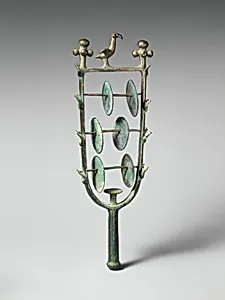
Medium
Copper alloy
Dimensions
13 1/16 × 4 5/16 × 2 1/16 in. (33.2 × 11 × 5.2 cm)
Classification
Metalwork-Implements
Culture & Period
Hattian · Early Bronze Age III
Department
Ancient Near Eastern Art
Museum
Metropolitan Museum of Art, New York, NY
Credit
Purchase, Joseph Pulitzer Bequest, 1955
Accession Number
55.137.1
Rights
Public Domain
Tags
Art Historical Context
This exquisite copper alloy sistrum, or rattle, hails from the Hattian culture of ancient Anatolia during the Early Bronze Age III (ca. 2300–2000 BCE). Crafted as a musical instrument, it exemplifies the sophisticated metalworking skills of the time, when artisans mastered casting and hammering copper alloys to create resonant objects for ritual and ceremonial use. Measuring about 13 inches tall, its form likely featured bird motifs—evident in its classification—symbolizing fertility, protection, or divine messengers in Near Eastern traditions. Sistra were shaken to produce a shimmering sound, often accompanying dances, prayers, or festivals in pre-Hittite Hattian society, bridging the mortal and spiritual realms. Though the artist remains unknown, the piece reflects the era's artistic focus on functional beauty, where everyday implements doubled as sacred tools. Its survival highlights the durability of bronze-age metallurgy. Today, this rare artifact resides in the Metropolitan Museum of Art's Ancient Near Eastern Art department, acquired through the Joseph Pulitzer Bequest in 1955. It invites visitors to imagine the rhythmic clamor of ancient rituals, connecting us to a vibrant world of sound and symbolism.