
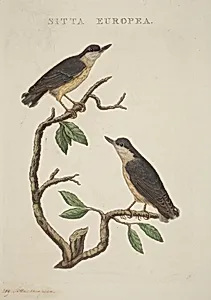
Sitta europea
1776 to 1800
Medium
hand-colored etching on laid paper
Dimensions
plate: 35.5 x 23.9 cm (14 x 9 7/16 in.) sheet: 54.6 x 37.7 cm (21 1/2 x 14 13/16 in.)
Classification
Department
CG-W
Museum
National Gallery of Art, Washington, D.C.
Credit
Collection of Mr. and Mrs. Paul Mellon
Accession Number
1985.64.118
Rights
Public Domain
Art Historical Context
Nestled in the National Gallery of Art's collection thanks to the generosity of Mr. and Mrs. Paul Mellon, *Sitta europea* is delicate hand-colored etching on laid paper from the late 18th (1776–1800). Depicting the European nuthatch—a small, acrobatic bird known for its-climbing prowess—this print measures a modest plate size of 35.5 x 23.9 cm, with a larger sheet of 54.6 x 37.7 cm. Created by an artist active into the 19th century, it exemplifies early American natural history illustration, bridging Enlightenment curiosity about the natural world with emerging national identity. Etching, a precise intaglio technique where acid bites into a metal plate to create fine lines, allowed for detailed feathers, perky posture, and subtle textures in the bird's portrayal. The hand-applied coloring—vibrant yet naturalistic—elevates it from scientific diagram to artistic gem, a common practice in period ornithological works. Laid paper, with its visible chain lines, speaks to traditional European papermaking methods still in use, underscoring transatlantic influences during America's formative years post-Revolution. This print's significance lies in its role as both educational tool and aesthetic object, reflecting the era's passion for cataloging nature amid scientific exploration. Visitors can appreciate how such works fueled biodiversity studies while delighting collectors with their charm.
About the Artist
American 19th Century · 1800–1900
The artist cataloged as "American, 19th Century" represents a collective of unidentified painters active in the United States during the nineteenth century, with 380 known artworks preserved in this virtual museum's collection. These works span a diverse array of genres typical of the era, including portraits, landscapes, still lifes, and genre scenes, reflecting the burgeoning artistic output of ...