
Six Angels
ca. 1365
Medium
Tempera on wood, gold ground
Dimensions
Top left 9 3/4 x 3 7/8 in. (24.8 x 9.8 cm); center left 11 1/8 x 5 1/4 in. (28.3 x 13.3 cm); bottom left 9 7/8 x 3 7/8 in. (25.1 x 9.8 cm); top right (9 3/4 x 3 7/8 in. (24.8 x 9.8 cm); center right 11 1/8 x 5 1/4 in. (28.3 x 13.3 cm); bottom right 10 x 3 7/8 in. (25.4 x 9.8 cm)
Classification
Paintings
Department
Robert Lehman Collection
Museum
Metropolitan Museum of Art, New York, NY
Credit
Robert Lehman Collection, 1975
Accession Number
1975.1.65a–f
Rights
Public Domain
Tags
Art Historical Context
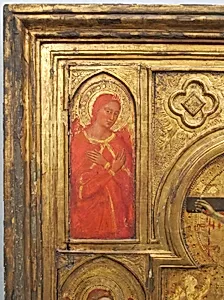
These six small panels of angels, painted 1365 by the Florentine artist Jacopo di Cione, once formed part of a larger altarpiece. Created in tempera on wood with a luminous gold ground, they reflect the devotional needs of 14th-century churches, where such figures would have flanked a central image of the Virgin or a saint. Jacopo, active during a period of artistic transition following the Black Death, worked within the refined Gothic tradition of Florence, emphasizing graceful poses and delicate patterning. The gold backgrounds, a hallmark of medieval religious painting, were not merely decorative but served to evoke the heavenly realm, drawing worshippers into a sense of the divine. Each angel is carefully individualized through subtle variations in gesture and drapery, showcasing the artist’s skill in working on a modest scale. These fragments, now in the Robert Lehman Collection at the Metropolitan Museum of Art, offer a glimpse into how Gothic altarpieces were designed as immersive, multi-paneled ensembles meant to inspire contemplation and prayer. Visitors can appreciate how such works combined technical precision with spiritual purpose, using the reflective quality of gold to animate the figures under candlelight. Though separated from their original context, the panels remain eloquent examples of early Italian religious art.