
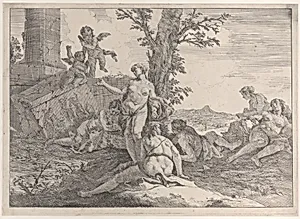
Six nymphs and two putti, from "Bacchanals and Histories"
Medium
Etching
Dimensions
Plate: 11 1/8 × 15 11/16 in. (28.3 × 39.8 cm) Sheet: 11 5/16 × 15 13/16 in. (28.8 × 40.1 cm)
Classification
Prints
Department
Drawings and Prints
Museum
Metropolitan Museum of Art, New York, NY
Credit
The Elisha Whittelsey Collection, The Elisha Whittelsey Fund, 1970
Accession Number
1970.683.3
Rights
Public Domain
Art Historical Context
In the lively etching *Six Nymphs and Two Putti*, from Francesco Fontebasso's series *Bacchanals and Histories* (1744), visitors encounter the exuberant spirit of Venetian Rococo art. Fontebasso, a prominent 18th-century Italian painter printmaker active in Venice, drew inspiration from the dramatic, playful style of Giovanni Battista Tiepolo. Created during Venice's golden age of decorative arts, this work captures the era's fascination with mythological revelry, evoking the joyous abandon of Bacchanalian feasts dedicated to the god Dionysus (Bacchus). The scene bursts with six graceful nymphs—ethereal female nature spirits—and two mischievous putti, the chubby infant cherubs symbolizing love and frolic. Rendered in etching, a technique Fontebasso mastered for its fluid lines and tonal depth, the print measures about 11 x 15 inches on the plate. Etching allowed artists like him to reproduce intricate compositions affordably, disseminating Rococo elegance to a wider audience beyond oil paintings. Housed in the Metropolitan Museum of Art's Drawings and Prints department as part of The Elisha Whittelsey Collection (acquired 1970), this piece exemplifies how prints bridged elite patronage and popular culture, inviting us to revel in 1740s Venice's whimsical mythology. A delightful glimpse into Fontebasso's dynamic draftsmanship!
About the Artist
Francesco Fontebasso · 1707–1769
Comment on works: Religious