
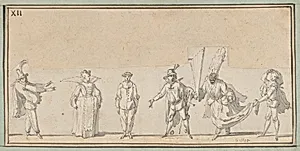
Six Studies of Commedia dell'Arte Actors: Polchinelle, Columbine, Pierrot, a Captain, Harlequin "en femme," and Scaramouche
early 18th century
Medium
pen and black ink with gray wash over graphite on laid paper, irregularly trimmed and laid down on a sheet touched with faded blue watercolor, on an old album sheet; partially incised for transfer
Dimensions
sheet: 7.7 × 16 cm (3 1/16 × 6 5/16 in.)
Classification
Drawing
Department
CG-E
Museum
National Gallery of Art, Washington, D.C.
Credit
Gift of Donald Stone
Accession Number
2022.40.18
Rights
Public Domain
Art Historical Context
In the early 18th century, artist Claude Gillot captured the vibrant world of Commedia dell'arte in this charming drawing, *Six Studies of Commedia'Arte Actors*. Featuring characters like the hunchbacked Polchinelle, graceful Columbine, melancholic Pierrot, swaggering Captain, cross-dressing Harlequin "en femme," and scheming Scaramouche, sketches evoke the lively improvisation and theatrical flair of this Italian comedy tradition, which captivated European audiences and influenced Rococo art. Gillot, a pioneering engraver and painter who mentored Antoine Watteau, executed the work in pen and black ink with gray wash over graphite on laid paper. The irregularly trimmed sheet, partially incised for transfer, reveals its preparatory role for printmaking—a technique highlighting Gillot's precision in rendering dynamic poses, exaggerated costumes, and expressive gestures on a compact 7.7 × 16 cm scale. Faded blue watercolor on the album sheet adds a subtle antique charm. Housed in the National Gallery of Art (gift of Donald Stone), this drawing offers a window into 18th-century popular culture, where Commedia dell'arte's stock figures symbolized human folly and romance, inspiring generations of artists to celebrate life's theatricality.
About the Artist
Claude Gillot · 1673–1722
Artist known for his elegant designs done in the Rococo manner of Audran; also for his predilection for scenes from the 'comedia dell'arte.' Few paintings survive; his work is known mainly through drawings and etchings. Comment on works: Genre; History