
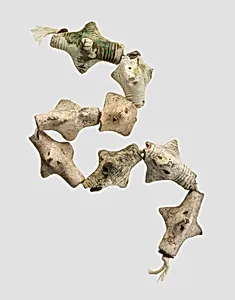
Sixteen beads
Unknown Artist
ca. 9th century BCE
Medium
Faience, glaze
Dimensions
1.57 x 1.14 in. (3.99 x 2.9 cm)
Classification
Faience-Ornaments
Culture & Period
Iran · Iron Age II, Hasanlu Period IV
Department
Ancient Near Eastern Art
Museum
Metropolitan Museum of Art, New York, NY
Credit
Purchase, The Adelaide Milton de Groot Fund, in memory of the de Groot and Hawley families, 1976
Accession Number
1976.233.6
Rights
Public Domain
Art Historical Context
Nestled in the Metropolitan Museum of Art's Ancient Near Eastern collection, *Sixteen Beads* offers a glimpse into the vibrant artistry of Iron Age Iran around the 9th century BCE. Crafted from faience—a composite of quartz, clay, and lime covered in a colorful glaze—these tiny ornaments measure just 1.57 x 1.14 inches. Faience was prized in the ancient world for its gem-like sheen and durability, mimicking semi-precious stones like lapis lazuli or turquoise at a fraction of the cost. Produced during Hasanlu Period IV the site of Hasanlu in northwest Iran, these beads showcase the sophisticated glazing techniques of the era, where artisans fired the material to achieve brilliant blues and greens that have endured for millennia. These beads hail from Iron Age II, a transformative period when iron tools revolutionized daily life and trade flourished across the Near East. Excavated from Hasanlu, a fortified settlement that bridged Median and Urartian influences, they likely served as jewelry components, amulets, or trade goods. Their small scale belies their cultural weight: such ornaments adorned the elite, symbolizing status and connecting wearers to broader networks of exchange from the Zagros Mountains to Mesopotamia. Though the artist remains unknown, *Sixteen Beads* exemplifies the anonymous mastery of ancient Iranian craftsmen, reminding us how everyday objects illuminate lost worlds. Acquired in 1976 through The Adelaide Milton de Groot Fund, they invite visitors to marvel at the ingenuity of a bygone age.