
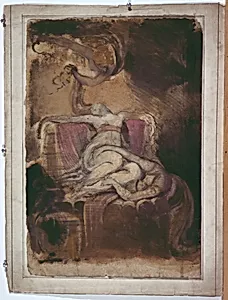
Sketch for 'Dido on the Funeral Pyre' (recto); Erotic Sketch of Man and Woman (verso)
c. 1781
Medium
Oil paint over charcoal (recto), and black chalk (verso), on ivory laid paper
Dimensions
53.9 × 37.2 cm (21 1/4 × 14 11/16 in.)
Classification
oil on paper
Department
Prints and Drawings
Museum
Art Institute of Chicago
Accession Number
113888
Rights
Public Domain
About this artwork
Dido, Queen of Carthage, was deserted by her lover Aeneas, a prince of Troy and a hero of the Trojan War. Devastated, she built a pyre to burn his possessions. Upon ascending the pyre and lamenting her cruel fate, Dido took her life with the sword she had given to Aeneas. In this preparatory sketch for a painting, Fuseli hews closely to the story as recounted in the ancient Roman poet Virgil’s epic poem about Rome’s founding, the Aeneid. Dido’s sister Anna weeps at the dead queen’s feet, while ...
Art Historical Context
Henry Fuseli, a leading figure of the Romantic movement, created this compelling double-sided sketch around 1781 while exploring dramatic literary themes. The recto depicts a study for “Dido on the Funeral Pyre,” drawn from Virgil’s Aeneid. It captures the Carthaginian queen in her final, tragic moments after being abandoned by Aeneas. Fuseli’s dynamic composition conveys intense emotion and impending doom, reflecting his fascination with passion, fate, and the sublime. Executed in oil paint over charcoal on ivory laid paper, the work demonstrates Fuseli’s experimental approach to sketching. This unusual combination allowed him to achieve rich tonal effects and rapid revisions typical of preparatory studies. On the verso, a private erotic drawing of a man and woman reveals the artist’s broader range, juxtaposing public tragedy with intimate sensuality. Housed in the Art Institute of Chicago’s Prints and Drawings department, this sheet offers visitors a rare glimpse into an artist’s creative process. Its 53.9 × 37.2 cm format preserves both the grandeur of classical narrative and the spontaneity of personal expression, underscoring Fuseli’s enduring influence on Romantic art.
About the Artist
Henry Fuseli · 1741–1825
Henry Fuseli (1741-1825), born Johann Heinrich Füssli in Zürich, was a Swiss-British painter whose visionary works exploring dreams, nightmares, and psychological terror made him one of the most original figures of the Romantic movement. His art bridged Neoclassical discipline with Romantic emotionalism, creating images of supernatural intensity that would influence artists from William Blake to t...