
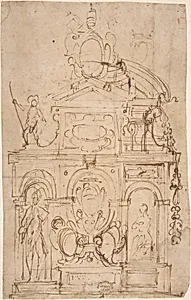
Sketch for Wall Monument
16th century
Medium
Pen and brown ink
Dimensions
8-1/8 x 5 in. (20.6 x 12.7 cm)
Classification
Drawings
Department
Drawings and Prints
Museum
Metropolitan Museum of Art, New York, NY
Credit
Gift of Cornelius Vanderbilt, 1880
Accession Number
80.3.626
Rights
Public Domain
Tags
Art Historical Context
This delicate pen and brown ink sketch, created by an anonymous Italian artist in the 16th, offers a glimpse into the preparatory world of Renaissance monument design. Titled *Sketch for Wall Monument*, depicts architectural elements intertwined with human figures, likely envisioning a commemorative wall structure—common in churches for honoring patrons, nobility, or clergy. At just 8-1/8 x 5 inches, its intimate scale suggests it was a studio study, used to refine ideas before committing to stone or marble. The use of pen and brown ink was a hallmark of 16th-century Italian draftsmanship, prized for its precision and fluidity. Artists employed fine lines to outline forms, hatching for depth and shadow, capturing the era's fascination with classical proportions and dynamic poses. This technique bridged the gap between idea and execution, reflecting the collaborative workshops of the High Renaissance and early Mannerism, where such drawings circulated as models. Generously gifted to the Metropolitan Museum of Art by Cornelius Vanderbilt in 1880, this work highlights the enduring appeal of preparatory sketches. It invites us to appreciate the unseen labor behind grand monuments, preserving a fleeting creative moment from Italy's artistic golden age.