
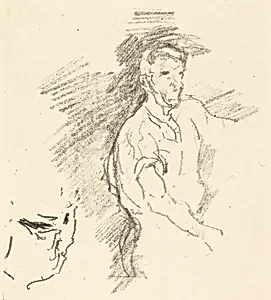
Sketch of a Blacksmith
Medium
lithograph in black on wove paper
Dimensions
image: 10.7 × 9.2 cm (4 3/16 × 3 5/8 in.) sheet: 17.2 × 11.7 cm (6 3/4 × 4 5/8 in.)
Classification
Department
CG-W
Museum
National Gallery of Art, Washington, D.C.
Credit
Rosenwald Collection
Accession Number
1943.3.8791
Rights
Public Domain
Art Historical Context
James McNeill Whistler’s *Sketch of a Blacksmith* (1895) is a captivating lithograph in black on wove paper, measuring a intimate 10.7 × 9.2 cm for the image itself. Created late in the artist’s career, this print exemplifies Whistler’s mastery of lithography—a planographic technique where drawings made with greasy crayon on stone are transferred to paper, allowing for fluid, spontaneous lines and subtle tonal gradations. The modest scale and black-on-white simplicity evoke the raw energy of a blacksmith at work, rendered with Whistler’s signature economy of means. Whistler, an American-born artist who championed the Aesthetic Movement in Britain, prioritized “art for art’s sake,” emphasizing harmony, tone, and suggestion over narrative detail. His lithographs from the 1880s and 1890s, including this one, often captured everyday urban life—laborers, streets, and workers—with a sketch-like immediacy that contrasted his more polished oils and pastels. This piece reflects his fascination with the working class, transformed into poetic abstraction through expert printing on smooth wove paper. Housed in the National Gallery of Art’s Rosenwald Collection, *Sketch of a Blacksmith* highlights lithography’s role in democratizing art, producing affordable multiples while showcasing technical innovation. It invites visitors to appreciate Whistler’s ability to distill industrial vigor into elegant minimalism, a bridge between 19th-century Realism and modern printmaking.
About the Artist
James McNeill Whistler · 1834–1903
James Abbott McNeill Whistler (1834-1903) was an American-born painter and printmaker who became a leading figure in the Aesthetic Movement and pioneer of Tonalism and Japonisme. He revolutionized art by championing "art for art's sake" and treating paintings as visual equivalents of musical compositions, titling works as "arrangements," "harmonies," and "nocturnes" to emphasize formal qualities o...