
Sketch of Statue: Bacchante by Bartolini
ca. 1850
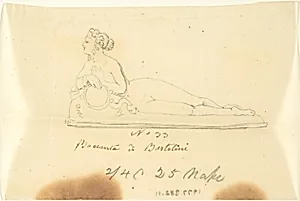
Medium
Graphite, with inscriptions in pen and brown ink on tracing paper
Dimensions
sheet: 3 1/16 x 4 7/16 in. (7.7 x 11.3 cm)
Classification
Drawings
Department
Drawings and Prints
Museum
Metropolitan Museum of Art, New York, NY
Credit
Gift of Mrs. John De Witt Peltz, 1977
Accession Number
1977.382.11
Rights
Public Domain
Tags
Art Historical Context
This delicate graphite sketch on tracing paper, created by British neoclassical sculptor John Gibson 1850, captures his rendition of *Bacchante*, a by the Italian artist Lorenzo Bartolini. Measuring just over 3 by 4 inches, the drawing depicts a nude female figure entwined with snakes—a classic symbol of the Bacchantes, ecstatic followers of the Roman god Bacchus (Dionysus). Gibson, who spent much of his career in Rome the city's ancient and contemporary sculptures, likely traced this as a study to analyze Bartolini's fluid forms and dynamic pose, a common practice for artists honing their craft in the neoclassical tradition. The use of tracing paper highlights Gibson's meticulous technique, allowing precise overlays to study anatomy and movement, enhanced by pen and brown ink inscriptions for notes or measurements. Bartolini's original marble *Bacchante* (ca. 1825–30), known for its romantic vitality amid neoclassical ideals, embodied the era's fascination with mythological sensuality and liberated femininity. Gibson's sketch thus bridges two masters, preserving a moment of artistic dialogue. Displayed in the Metropolitan Museum of Art's Drawings and Prints department, this intimate work reveals the behind-the-scenes labor of 19th-century sculpture, inviting visitors to appreciate how sketches like this fueled grander creations. (198 words)
About the Artist
John Gibson · 1790–1866
Outstanding Neoclassical sculptor who experimented with the ancient practice of coloring statues, e.g. his 'Tinted Venus' (1851). Flaxman encourgaged him to go to Rome, where he spent most of his life. He left his fortune to the National Gallery, London. British sculptor, active Rome. Comment on works: sculptor