
Sketch of William E. Henley
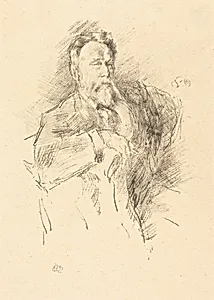
Medium
lithograph in black on laid paper
Dimensions
image: 17.2 × 13.2 cm (6 3/4 × 5 3/16 in.) sheet: 26.9 × 19.2 cm (10 9/16 × 7 9/16 in.)
Classification
Department
CG-W
Museum
National Gallery of Art, Washington, D.C.
Credit
Rosenwald Collection
Accession Number
1943.3.8781
Rights
Public Domain
Art Historical Context
James McNeill Whistler’s *Sketch of William E.* (1896) captures the rugged intensity of the Victorian poet and critic in a compact, evocative lithograph. Henley, famed for his defiant poem “Invictus” and his influential editorship of magazines like the *National Observer*, was a close and sometime sparring partner of Whistler. Created late in the artist’s career, this work reflects Whistler’s fascination with bold personalities and his commitment to “art for art’s sake,” prioritizing tonal harmony over narrative detail. Rendered in black ink on laid paper, the lithograph measures just 17.2 × 13.2 cm, inviting intimate viewing. Whistler, a master of the medium, exploited lithography’s crayon-like fluidity to achieve subtle gradations and a sketch-like spontaneity—hallmarks of his printmaking innovation. Unlike his ethereal nocturnes or butterfly-signed oils, this piece channels a direct, almost confrontational portraiture, echoing his realist roots while embracing Aestheticism’s refined subtlety. Housed in the National Gallery of Art’s Rosenwald Collection, this print exemplifies Whistler’s late-19th-century push to elevate prints as fine art. For visitors, it offers a window into the bohemian London circles where literature and visual art intertwined, reminding us of enduring bonds between creators.
About the Artist
James McNeill Whistler · 1834–1903
James Abbott McNeill Whistler (1834-1903) was an American-born painter and printmaker who became a leading figure in the Aesthetic Movement and pioneer of Tonalism and Japonisme. He revolutionized art by championing "art for art's sake" and treating paintings as visual equivalents of musical compositions, titling works as "arrangements," "harmonies," and "nocturnes" to emphasize formal qualities o...