
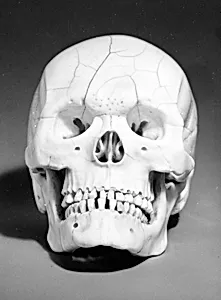
Skull
Unknown Artist
17th century
Medium
Ivory
Dimensions
Height: 3 1/16 in. (7.8 cm)
Classification
Sculpture-Miniature
Culture
German or Netherlandish
Department
European Sculpture and Decorative Arts
Museum
Metropolitan Museum of Art, New York, NY
Credit
Gift of Mrs. Charles Wrightsman, 1988
Accession Number
1988.334
Rights
Public Domain
Tags
Art Historical Context
Nestled in the Metropolitan Museum of Art's European Sculpture and Decorative collection, this exquisite miniature ivory skull, crafted by an unknown German or Netherlandish artist the 17th century stands just 3 1/16 inches (7.8 cm) tall. Such diminutive sculptures were prized as personal talismans, evoking the vanitas tradition popular in Northern Europe during the Baroque era. Skulls like this served as poignant *memento mori*—reminders of mortality—ing viewers to contemplate life's fleeting nature amid the era's religious fervor and plague-scarred history. Carved from ivory, a luxurious material revered for its smooth, bone-like translucency and workability, the artist achieved remarkable anatomical precision in this tiny form. Ivory miniatures demanded extraordinary skill, often produced in workshops in cities like Nuremberg or Antwerp, blending sculpture with decorative arts. This piece's tactile quality and lifelike details—perhaps subtle cracks or sutures—invite close inspection, blurring the line between art and relic. A generous gift from Mrs. Charles Wrightsman in 1988, this skull endures as a window into 17th-century sensibilities, where art confronted death with quiet eloquence. Visitors are drawn to its haunting intimacy, a timeless whisper of human fragility.