
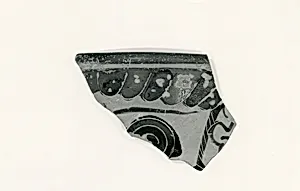
Skyphos fragment
Unknown Artist
6th century BCE
Medium
Terracotta
Dimensions
width 8.00 cm.
Classification
Vases
Culture & Period
Greek, Attic · Archaic
Department
Greek and Roman Art
Museum
Metropolitan Museum of Art, New York, NY
Credit
Gift of Dietrich von Bothmer, 1981
Accession Number
1982.227
Rights
Public Domain
Art Historical Context
This delicate terracotta fragment from a skyphos, a popular two-handled drinking cup in ancient Greece, dates to the 6th BCE during the Archaic period.ailing from Attic workshops near Athens, it measures just 8 cm in, offering a glimpse into the everyday elegance of Greek symposia—lively social gatherings where wine flowed and stories were shared. As part of the Metropolitan Museum of Art's Greek and Roman Art collection, gifted by the renowned scholar Dietrich von Bothmer 1981, it the durability and artistry of Attic pottery. Crafted from fired clay, this vase fragment reflects the technical mastery of Archaic Greek potters, who shaped vessels on wheels and often decorated them with black-figure or transitional techniques using slip (liquid clay) fired to a glossy black. Though incomplete, it hints at the standardized forms that made Attic wares highly prized for export across the Mediterranean, spreading Greek myths, motifs, and culture far and wide. In a broader sense, such skyphoi were more than mere cups; they embodied the Archaic era's cultural flowering, bridging the rigid Geometric style and the dynamic Classical period. This fragment invites us to ponder the hands that once held it—perhaps an Athenian reveler toasting to the gods—preserving a tangible link to antiquity's vibrant world.