
Slag bij Jutphaas
Medium
striking (metalworking)
Dimensions
7.11; 2.8; 3.1
Rights
Public Domain
About this artwork
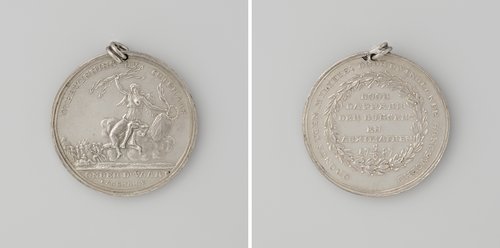
Zilveren penning met draagoog en draagring. Voorzijde: vrouw, zittend op wolk, houdt in haar linkerhand palmtak, lauwerkrans en wapenschild en slingert met haar andere hand bliksemschichten naar vluchtende soldaten binnen omschrift; afsnede: opschrift. Keerzijde: opschrift binnen lauwerkrans en omschrift
Art Historical Context
### Slag bij Jutphaas Crafted in 1787 by Dutch medalist Johannes Michiel Lageman, *Slag bij Jutphaas* is a finely struck silver medal measuring just 3.1 cm in diameter, complete with an eyelet and ring for wearing or display. This petite metalwork exemplifies 18th-century European medal art, where engraving and striking techniques allowed for intricate, high-relief designs on small scales. Such medals served as portable commemorations, blending artistry with propaganda to celebrate pivotal events. The obverse features a powerful female figure—likely symbolizing Victory or divine retribution—seated on a cloud. In her left hand, she grasps a palm branch, laurel wreath, and shield, while her right hurls lightning bolts at fleeing soldiers below, encircled by inscriptions. The reverse bears text within a laurel wreath, framed by an outer band, emphasizing triumph through classical motifs of glory and retribution. This medal marks the Battle of Jutphaas (September 9, 1787), a clash in the Dutch Patriot Revolution where Prussian forces aiding Stadtholder William V routed Patriot rebels near modern-day Nieuwegein. It captures the era's political fervor, using neoclassical allegory to glorify the victors and underscore the short-lived Patriot push for reform in the Dutch Republic. A snapshot of revolutionary turbulence, it highlights medals' role in shaping public memory.