
Slag bij Waterloo
Medium
striking (metalworking)
Dimensions
3.7; 13.61
Rights
Public Domain
About this artwork
diameter 3.7 cm x weight 13.61 gr
Art Historical Context
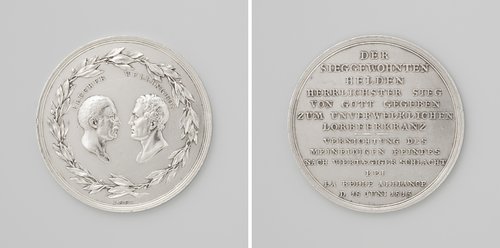
This striking 1815 medal by German medallist Daniel Friedrich Loos captures the decisive Battle of Waterloo, a turning point that ended Napoleon’s rule. Measuring just 3.7 centimeters across and weighing 13.61 grams, the small circular piece was created through the traditional technique of striking—pressing designs into metal with engraved dies. Such medals served as portable souvenirs and historical records, allowing people across Europe to hold a tangible reminder of the Allied victory led by Wellington and Blücher. Loos, active in the late eighteenth and early nineteenth centuries, specialized in commemorative works that blended precise portraiture with symbolic imagery. His Waterloo medal reflects the neoclassical style popular at the time, favoring clear profiles and balanced compositions suited to the limited surface of a coin-like object. Though modest in scale, these pieces carried wide cultural weight, circulating news of great events in an era before photography or mass media. Today the medal offers visitors a direct connection to 1815, illustrating how art and metalworking preserved public memory of one of history’s most famous battles.
About the Artist
Daniel Friedrich Loos · 1735–1819
Daniel Friedrich Loos (1735–1819) was a German medallist, engraver, and die-cutter who served as chief engraver and medalist for the Kingdom of Prussia during a crucial period of Prussian history. Born on June 15, 1735, in Altenburg and dying on October 1, 1819, in Berlin, Loos pursued an 84-year life that spanned from the reign of Frederick William I through the Napoleonic Wars and into the post-...