
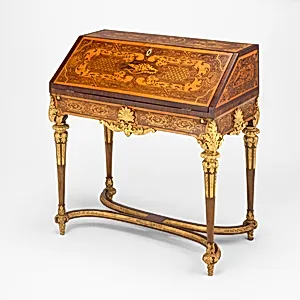
Slant-Front Desk
c. 1720
Medium
Marquetry with maple, amaranth, mahogany, and walnut on spruce and oak
Dimensions
90.2 × 84.5 × 46.1 cm (35 1/2 × 33 1/4 × 18 1/8 in.)
Classification
desk
Department
Applied Arts of Europe
Museum
Art Institute of Chicago
Accession Number
187069
Rights
Public Domain
About this artwork
German cabinetmaker Heinrich Ludwig Rohde worked in Mainz, a prosperous university town on the Rhine River. As court cabinetmaker to Elector Lothar Franz Schönborn, Archbishop of Mainz and Prince of the Holy Roman Empire, Rohde was responsible for much of the decoration at the Schönborn’s sumptuous palace at Pommersfelden, from the marquetry floors and mirrored cabinets to the porcelain-decorated rooms. The marquetry incorporates varieties of wood that would have been readily available in Germa...
Art Historical Context
**Slant-Front Desk Heinrich Ludwig Rohde (. 1720)** Crafted around 1720 by German cabinetmaker Heinrich Ludwig Rohde this slant-front desk exemplifies the exquisite furniture of early 18th-century. Measuring 90.2 × 84.5 × 46.1 cm, it served as both a practical writing station and a status symbol for the educated elite. The slant-front design, hinged to reveal compartments for papers and inks, reflects the rising demand for versatile home offices amid growing literacy and commerce during the late Baroque era. Rohde's mastery shines in the marquetry technique—a labor-intensive process of cutting and inlaying thin veneers of maple, amaranth, mahogany, and walnut onto spruce and oak cores. This created intricate floral or geometric patterns (typical of the period), showcasing the wood's natural grains and colors for a luxurious, jewel-like effect. Exotic imports like mahogany highlight global trade networks linking Europe to the Americas and Asia. Housed in the Art Institute of Chicago's Department of Applied Arts of Europe, this desk bridges art and utility, embodying the era's blend of functionality and opulence. Visitors can appreciate how such pieces furnished grand interiors, whispering tales of craftsmanship that endured centuries.