
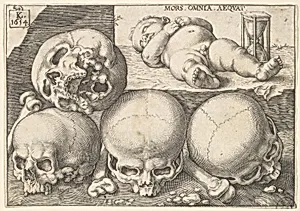
Sleeping Child with Four Skulls (reverse copy)
1595–1637
Medium
Engraving; reverse copy
Dimensions
Sheet: 2 1/8 × 3 1/16 in. (5.4 × 7.7 cm)
Classification
Prints
Department
Drawings and Prints
Museum
Metropolitan Museum of Art, New York, NY
Credit
Gift of Harry G. Friedman, 1962
Accession Number
57.658.40
Rights
Public Domain
Tags
Art Historical Context
In the quiet intimacy of this small engraving, *Sleeping Child with Four Skulls (reverse copy)*, we encounter a poignant memento mori from the late Renaissance. Created by Lucas Kilian (1595–1637) as a reverse copy of an original by Barthel Beham—one of the German "Little Masters" known for intricate small-scale prints—the image depicts a serene, sleeping infant cradled amid four skulls and an hourglass. Measuring just over 2 inches wide, this delicate work invites close contemplation, its tiny scale mirroring the fragility of life it evokes. Engraving, a meticulous intaglio technique where lines are incised into a metal plate for inking and printing, allowed artists like Kilian and Beham to produce affordable, reproducible images that spread moral and philosophical ideas across Europe. The reversed composition—flipped left-to-right from Beham's prototype—was a common printmaker's practice, possibly for artistic variation or transfer purposes. Produced during the early 17th century, amid plague and religious turmoil, the artwork embodies vanitas themes: the skulls symbolize mortality, the hourglass fleeting time, and the innocent child a stark reminder that death spares no one. Today, this print resides in the Metropolitan Museum of Art's Drawings and Prints department, a gift from Harry G. Friedman in 1962. It captures the era's obsession with transience, blending tender realism with stark symbolism to provoke reflection on life's brevity.
About the Artist
Lucas Kilian|Barthel Beham · 1579–1637
Lucas Kilian (1579–1637) was one of the most celebrated engravers of early 17th-century Germany and the most prominent member of the Kilian dynasty of printmakers in Augsburg. Born in Augsburg in 1579, Lucas Kilian achieved international recognition for his technically virtuosic engravings and became a leading figure in the transition from late Renaissance to early Baroque printmaking styles. His ...