
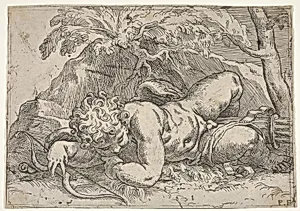
Sleeping Cupid
ca. 1560–1606
Medium
Etching
Dimensions
Sheet (Trimmed): 7 13/16 × 5 1/2 in. (19.9 × 14 cm)
Classification
Prints
Department
Drawings and Prints
Museum
Metropolitan Museum of Art, New York, NY
Credit
Bequest of Phyllis Massar, 2011
Accession Number
2012.136.96
Rights
Public Domain
Tags
Art Historical Context
Paolo Farinati's *Sleeping Cupid*, an exquisite etching from around 1560–1606, captures the mythological god of love in a moment of serene vulnerability. Reclining gracefully with his bow and arrow nearby, the youthful Cupid embodies the Renaissance fascination with classical antiquity, where the winged deity symbolized both desire and its fleeting power. Farinati, a Veronese Mannerist painter and printmaker (c. 1524–1606), drew inspiration from masters like Michelangelo, infusing his works with elongated forms and emotional intensity. Etching, a relatively new technique in the 16th century, allowed Farinati to achieve fluid, expressive lines that convey the softness of sleep and the delicate texture of Cupid's skin and wings. Unlike the rigid precision of engraving, etching's acid-bitten plates enabled a painterly quality, making prints like this one accessible reproductions of his artistry. Housed in the Metropolitan Museum of Art's Drawings and Prints department, this trimmed sheet (7 13/16 × 5 1/2 in.) reflects the era's booming print market, which democratized art for collectors across Europe. This intimate work highlights Mannerism's playful twist on classical themes, inviting viewers to ponder love's unguarded side. A bequest from Phyllis Massar in 2011, it remains a gem for appreciating Farinati's technical virtuosity and the enduring allure of Cupid.
About the Artist
Paolo Farinati · 1524–1606
Italian painter and engraver. Comment on works: Religious