
Sleeve Band
Unknown Artist
19th century
Medium
Silk; on silk
Dimensions
46 x 4 in. (116.84 x 10.16 cm)
Classification
Textiles-Embroidered
Culture & Period
China · Qing dynasty (1644–1911)
Department
Asian Art
Museum
Metropolitan Museum of Art, New York, NY
Credit
Bequest of William Christian Paul, 1929
Accession Number
30.75.227
Rights
Public Domain
Tags
Art Historical Context
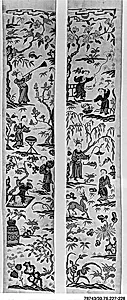
Welcome to the Asian Art galleries at the Metropolitan Museum of Art, where we encounter the exquisite *Sleeve Band*, a delicate embroidered silk textile from 19th-century Qing dynasty China (1644–1911). Measuring a slender 46 x 4 inches, this narrow band was likely designed to adorn the sleeves of formal robes, a hallmark of imperial-era fashion among the elite. Crafted entirely from silk—both the ground fabric and the threads—this piece exemplifies the pinnacle of Chinese textile artistry, where embroidery transformed simple cloth into symbols of status and refinement. The design features intricate motifs of trees and human figures, rendered with masterful needlework that brings nature and daily life to vivid reality. Trees, often evoking longevity and harmony in Chinese symbolism, intertwine with stylized human forms, possibly depicting scenes of leisure or auspicious narratives. Techniques such as fine satin stitching and padding created texture and depth, showcasing the anonymous artisan's skill in color gradation and composition—hallmarks of Qing embroidery workshops. Bequeathed to the Met in 1929 by William Christian Paul, this sleeve band offers a window into the opulent world of Qing court attire, governed by strict sumptuary laws that dictated motifs and materials by rank. It reminds us how textiles were not mere garments but cultural canvases, blending artistry with social hierarchy in imperial China.