
Slipper Chair
ca. 1860
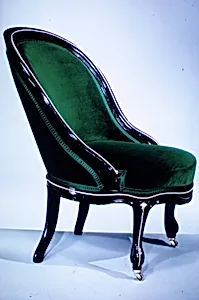
Medium
Maple, brass
Dimensions
31 1/8 x 22 7/8 x 24 3/4 in. (79.1 x 58.1 x 62.9 cm)
Classification
Slipper chair
Culture
American
Department
The American Wing
Museum
Metropolitan Museum of Art, New York, NY
Credit
Gift of Mrs. Zelina C. Brunschwig, 1968
Accession Number
68.158
Rights
Public Domain
Art Historical Context
Step into the elegant world of 19th American interiors with Alexander Roux's *Slipper Chair* (ca. 1860), a masterful example of Rococo Revival furniture. Craft from maple—a durable, light-toned hardwood ideal for intricate carving—and accented with gleaming brass, this compact armchair measures just 31 1/8 x 22 7/8 x 24 3/4 inches, perfect for intimate spaces like boudoirs or dressing rooms. Its low, slipper-like seat and gently curved form evoke comfort and femininity, hallmarks of the style. French-born cabinetmaker Alexander Roux, who established a prominent workshop in New York City after immigrating in the 1830s, championed the Rococo Revival movement. This mid-19th-century aesthetic revived the playful, asymmetrical curves and floral motifs of 18th-century French Rococo, blending them with American practicality. Roux's chairs often featured such lavish detailing, showcasing his expertise in marrying European opulence with burgeoning U.S. tastes during a booming era of industrialization and social refinement. Housed in The Metropolitan Museum of Art's American Wing and gifted by Mrs. Zelina C. Brunschwig in 1968, this piece highlights the cultural fusion of immigrant artistry in shaping American design. It invites us to imagine Victorian ladies lounging in silk gowns, a testament to furniture's role in everyday luxury.