
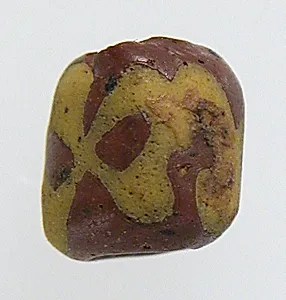
Small Bead
Unknown Artist
500–600
Medium
Glass
Dimensions
Overall: 3/16 x 3/16 in. (0.5 x 0.5 cm)
Classification
Glass-Beads
Culture
Frankish
Department
Medieval Art
Museum
Metropolitan Museum of Art, New York, NY
Credit
Gift of J. Pierpont Morgan, 1917
Accession Number
17.193.20
Rights
Public Domain
Art Historical Context
This diminutive glass bead, measuring just 3/16 x 3/16 inches, hails from the Frankish culture of the Merovingian period (500–600 CE). Crafted by an unknown artisan, it exemplifies the everyday artistry of early medieval Europe, when the Franks—Germanic tribes who established a powerful kingdom in what is now and Germany—were expanding their influence. Such tiny objects were likely components of jewelry, amulets, or trade goods, reflecting a world where portable adornments held both practical and symbolic value. Glass bead-making was a sophisticated technique in this era, involving the careful shaping of molten glass into uniform spheres. Frankish craftsmen drew on Roman traditions while innovating with local resources, producing beads that circulated widely through trade networks across Europe and beyond. This "Small Bead" highlights the technical skill required for such precision on a microscopic scale, offering a window into the material culture of a formative time before the Carolingian Renaissance. Today, housed in the Metropolitan Museum of Art's Medieval Art department as part of J. Pierpont Morgan's 1917 gift, it reminds us that grand history often unfolds through humble artifacts. Though unassuming, it connects us to the daily lives of people 1,500 years ago.