
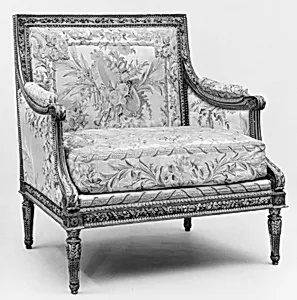
Small settee (part of a set) (part of a set)
Medium
Carved and gilded walnut; 18th-century embroidered silk-satin (not original to the frame)
Dimensions
Overall: 37 1/2 × 37 1/2 × 28 3/4 in. (95.3 × 95.3 × 73 cm)
Classification
Woodwork-Furniture
Culture
French, Paris
Department
European Sculpture and Decorative Arts
Museum
Metropolitan Museum of Art, New York, NY
Credit
Gift of Samuel H. Kress Foundation, 1958
Accession Number
58.75.27
Rights
Public Domain
Art Historical Context
This elegant small settee, created around 1785 Paris, exemplifies the refined neoclassical taste that flourished during the reign of Louis XVI. Crafted by master furniture maker Georges Jacob in collaboration with celebrated silk designer Philippe de Lasalle, the piece reflects France’s golden age of decorative arts just before the Revolution. Its graceful proportions and delicate carving capture the era’s shift toward lighter, more archaeological forms inspired by ancient Greece and Rome. The settee’s carved and gilded walnut frame showcases Jacob’s exceptional skill in joinery and ornament, while the embroidered silk-satin upholstery—though not original to the frame—features delicate rose motifs typical of de Lasalle’s luxurious Lyon textiles. Such furniture was designed for intimate salons, where comfort met opulence. Part of a larger suite, it highlights the collaborative nature of eighteenth-century French luxury production, blending woodworking and textile arts. Today in the Metropolitan Museum’s collection, this settee offers visitors a glimpse into the sophisticated domestic world of pre-revolutionary France. Its survival as a gift of the Samuel H. Kress Foundation reminds us how these objects continue to convey the elegance and artistry of their time.