
Small Torso of Iris
modeled probably ca. 1906–9, cast ca. 1970
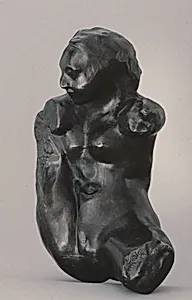
Medium
Bronze, black marble base
Dimensions
Overall (with base): 7 1/2 × 3 5/8 × 2 3/4 in. (19.1 × 9.2 × 7 cm); Height (without base): 6 1/8 in. (15.6 cm)
Classification
Sculpture-Bronze
Culture
French
Department
European Sculpture and Decorative Arts
Museum
Metropolitan Museum of Art, New York, NY
Credit
Gift of Iris and B. Gerald Cantor Foundation, 1984
Accession Number
1984.364.5
Rights
Public Domain
Tags
Art Historical Context
Auguste Rodin's *Small Torso of Iris*, modeled around 1906–9 and cast in bronze about 1970, captures the ethereal grace of Iris, the Greek goddess of the rainbow and divine messenger. This intimate sculpture, standing just over six inches tall without its sleek black marble base, exemplifies Rodin's late-career fascination with fragmented forms. Rather than full figures, he often sculpted torsos to emphasize raw emotion, movement, and the play of light on undulating surfaces, drawing from his Impressionist influences and classical antiquity. Crafted in bronze—a medium Rodin championed for its durability and ability to hold rich patinas—this piece showcases his innovative lost-wax casting technique, allowing for multiple editions long after his death in 1917. The torso's dynamic twist evokes Iris's swift, airborne journeys across the sky, with textured skin and abbreviated limbs highlighting anatomical tension and vitality. Housed in the Metropolitan Museum of Art's European Sculpture and Decorative Arts department, it was generously gifted by the Iris and B. Gerald Cantor Foundation in 1984, adding a poetic nod to the goddess's name. Rodin's torsos revolutionized sculpture by prioritizing sensation over completeness, bridging 19th-century realism with modernist abstraction. This small-scale marvel invites visitors to ponder the goddess's fleeting beauty up close, a testament to French artistic innovation.
About the Artist
Auguste Rodin · 1840–1917
François Auguste René Rodin (1840-1917) stands as the founder of modern sculpture, transforming the art form from academic tradition into expressive modernism. Born into a working-class Parisian family, Rodin faced early rejection, failing three times to gain admission to the prestigious École des Beaux-Arts. This setback forced him to work as a craftsman for nearly two decades, though his 1875 tr...